
🏺 USING AN ELECTRIC KILN IN CERAMICS
🔥 DRYING
Pieces must go into the kiln as dry as possible, with only slight moisture due to environmental presence being acceptable.
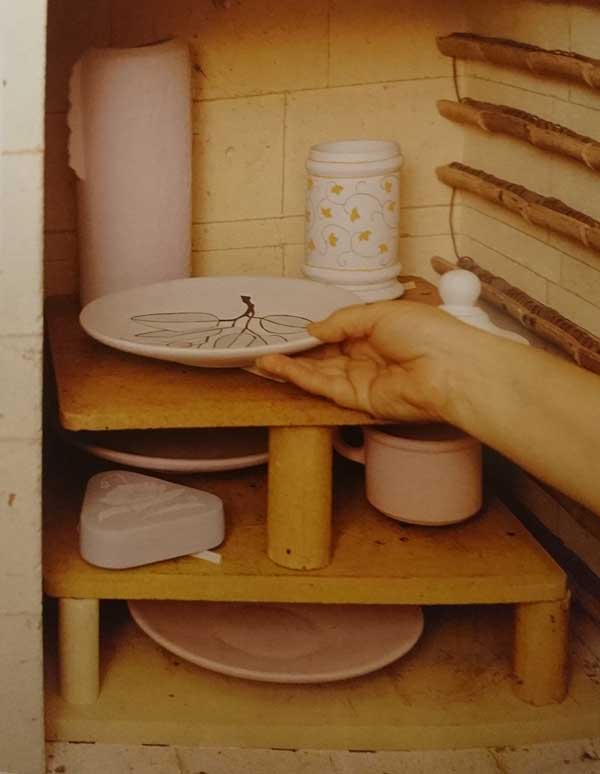
Drying time depends on the thickness of the piece and the season. With high heat and low humidity, 1 week is enough time to dry small pieces.
An easy and reliable way to check the drying level of a piece is to compare its color with one that is already completely dry (obviously if they were made with the same clay/paste).
A piece that is not dry will explode (*) during firing and will likely affect other pieces around it and may even damage the heating elements. Air bubbles also cause pieces to explode.
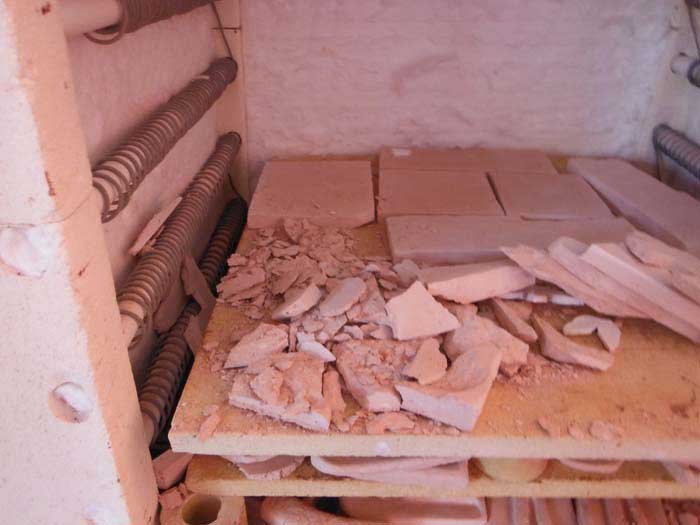
DRYING | RULES
To avoid moisture, we do not make "large" solid pieces.
For tiles, the thickness should not exceed 2 centimeters.
We can pierce the bottom of a piece to allow for better drying.
During drying, pieces cannot be "restricted" so they can contract without constraints.
Use the kiln (with the chimney open) to dry pieces if there are doubts about their dryness. However, avoid this procedure due to the corrosion it causes in the kiln.
Fragile pieces or those that may warp should be dried as slowly as possible. The ideal is to cover them with plastic so that their internal humidity is homogeneous and drying is as slow as possible.
🔥 THE FIRING
It is the bisque (chacota) firings that corrode a kiln.
The gases expelled during firing are toxic.
An electric ceramic kiln is also called a MUFFLE.
Firing is the final and irreversible step for ceramic material: silica inversion at 573 degrees Celsius, both during heating and cooling (transformation of alpha quartz to beta and vice versa).
A piece can be subjected to several firings, but the succession of these on fragile pieces considerably increases the probability of cracks and breaks appearing.
🔥 TYPES OF KILNS
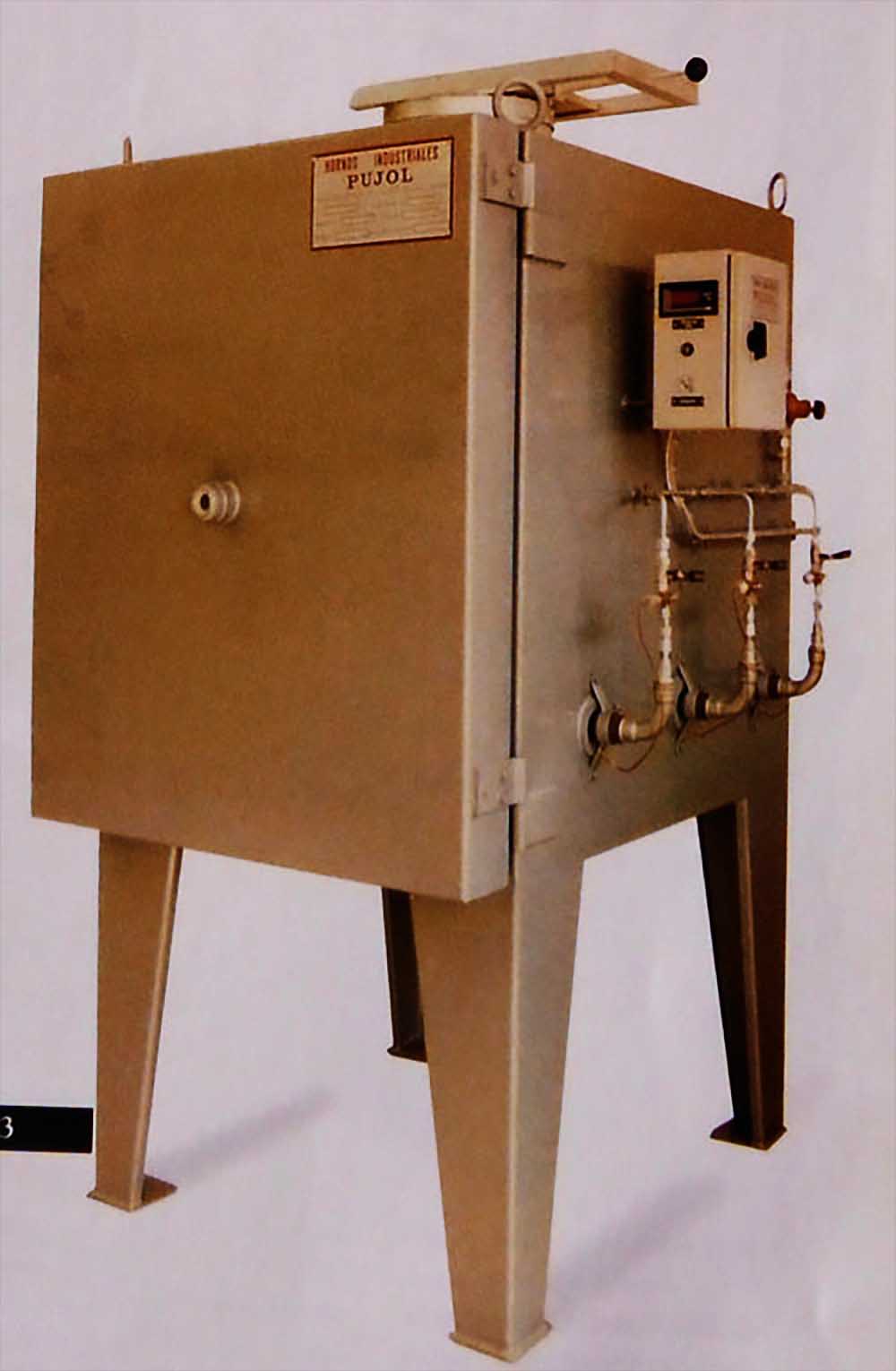
The kilns normally used in studios are gas and electric. Gas kilns are less expensive in terms of energy and also less safe...
A gas kiln can reach temperatures above 1200/1300 degrees. Burners introduce the gas, which can be natural, propane, or butane.
🔥 TYPES OF ATMOSPHERE
A Reducing Atmosphere is obtained in kilns with wood/oil fuels that release carbon and cause a consequent decrease in oxygen.
An Oxidizing atmosphere is obtained in electric kilns.
A gas kiln allows for a reducing or oxidizing atmosphere by controlling the air intake in the burner.
In a reducing atmosphere, coloring oxides that release oxygen will be affected: iron oxide and copper oxide. These metallic oxides will change color.
Copper oxide (which exists in various oxidation states) produces green color in lead glazes and turquoise in alkaline ones. In a reducing atmosphere, it provides red colors.
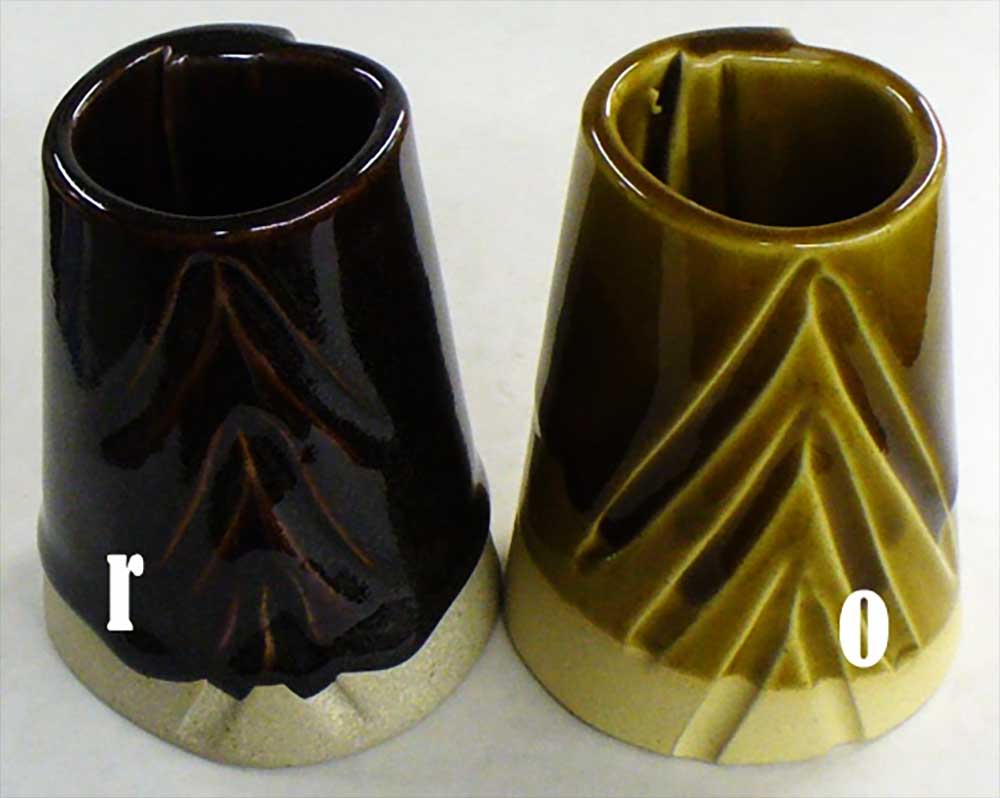
In an electric kiln, it is not convenient to produce a reducing atmosphere because it would damage the electric heating elements.
Clay fired in a reducing atmosphere looks different because it contains iron.
Electric kilns can be single-phase or three-phase. Single-phase power allows for kilns up to approx. 50 liters capacity and normally does not exceed 4kw.
There are kilns with top loading, but the most common is front loading.
🔥 KILN COMPONENTS | part I
Basically, a kiln consists of a combustion chamber (A) and a controller (B).
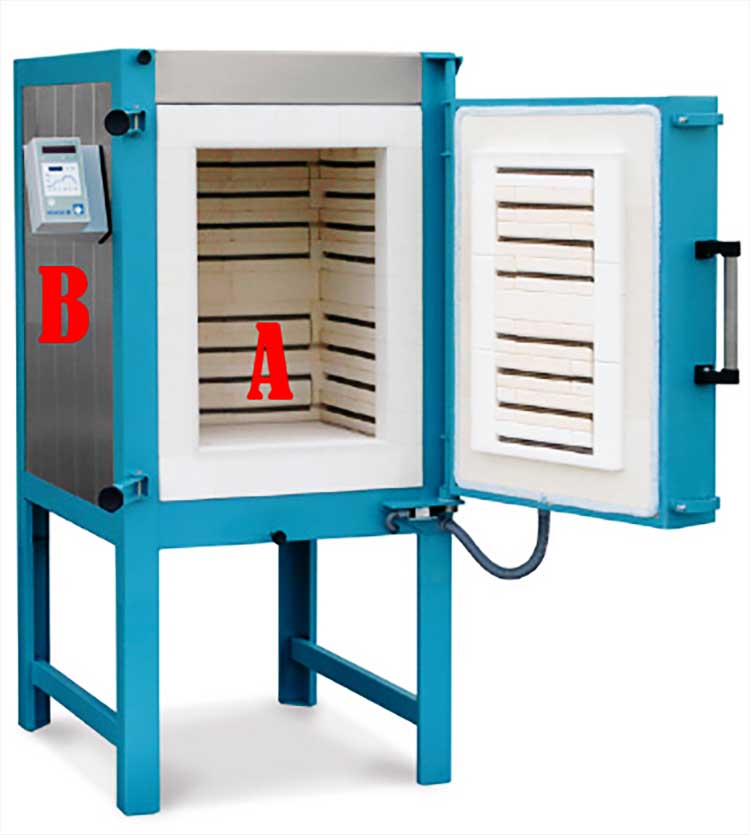
The chamber is an iron/steel structure lined internally with refractory material: bricks and blanket (ceramic fiber).
🔥 ELECTRIC HEATING ELEMENTS
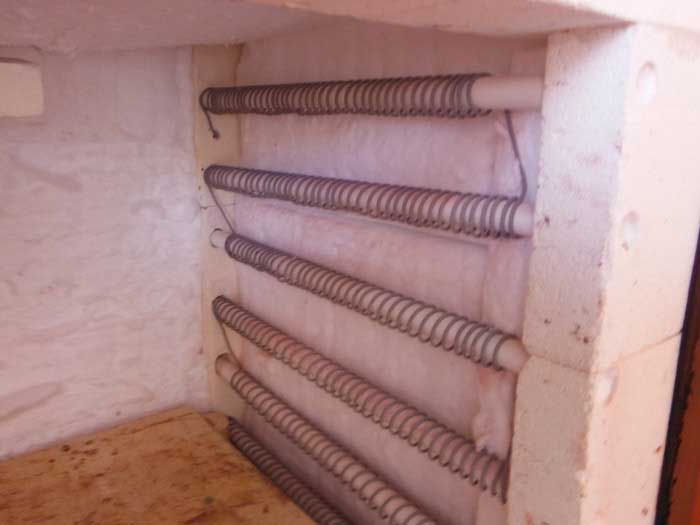
Interior of a kiln showing the elements and the refractory lining: blanket and bricks.
The pyrometric probe is prepared with 2 different metal wires, welded at one end, known as a thermocouple.
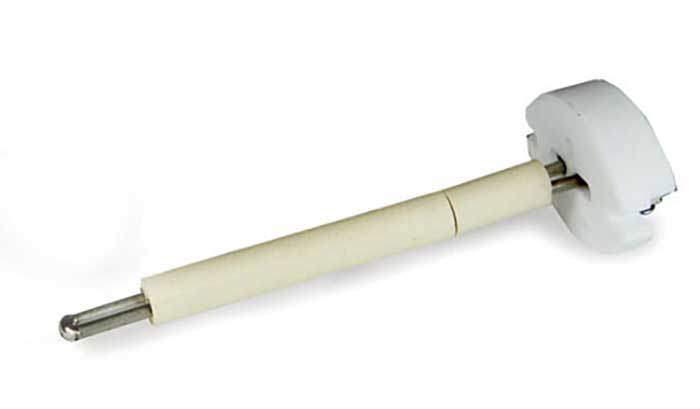
Heat comes from electric elements and the temperature reading is performed by a pyrometric probe.
When there is a temperature difference between the joined end and the free ends, a potential difference arises that can be measured by a voltmeter.
Elements are made of nichrome alloys (nickel and chromium) and more commonly Khantal, which is the brand of electric resistors that allows temperatures above 1100 degrees.
Elements can be distributed only on the 2 side walls, or also on the kiln base and even on the door. Obviously, the more distributed they are, the more uniform the heat is in the kiln.
Elements become brittle during firings, so it is convenient that they are not touched and certainly not hit by any piece. Therefore, handle them very carefully when removing a piece of clay that has become stuck in them due to a piece exploding.
To clean, simply brush them gently with a paintbrush or a vacuum cleaner, starting from the upper parts. To finish, remove all dust accumulated at the base of the kiln.
🔥 KILN COMPONENTS | part II
The kiln usually has a chimney to expel gases and vapors from the firing.
The controller/programmer can be analog or digital, and the most advanced ones allow for a firing with only one visit to the kiln.
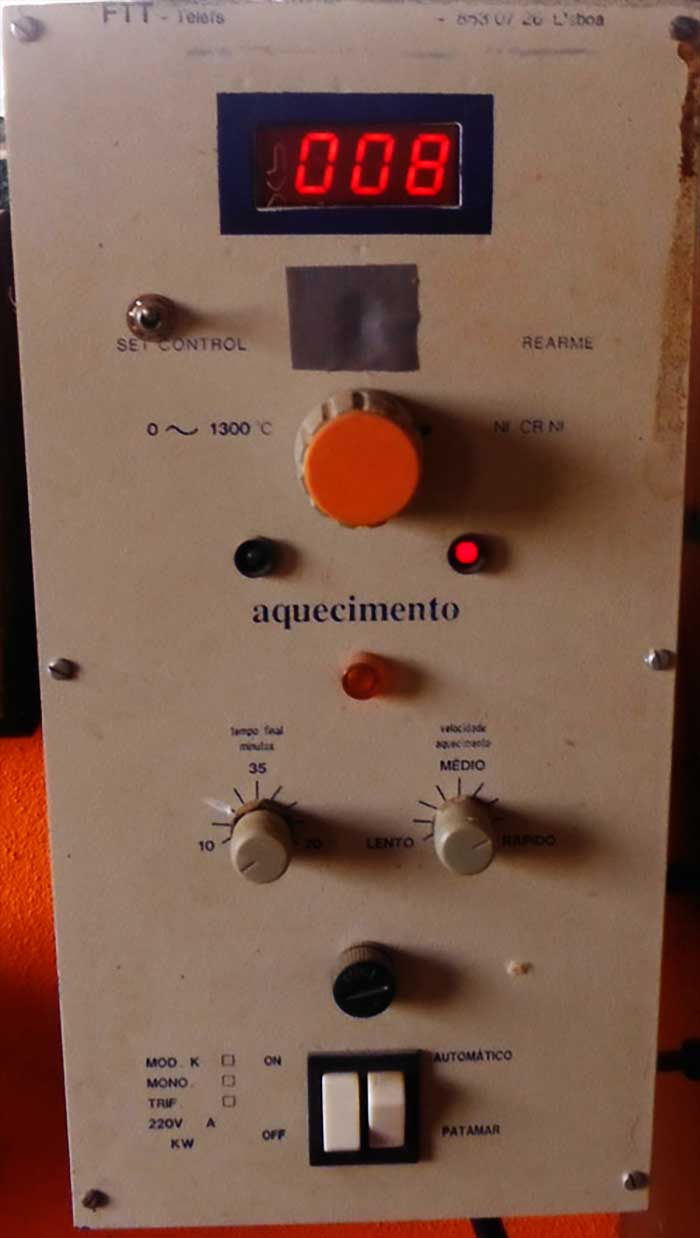
The programmer can always be replaced by a more sophisticated one.
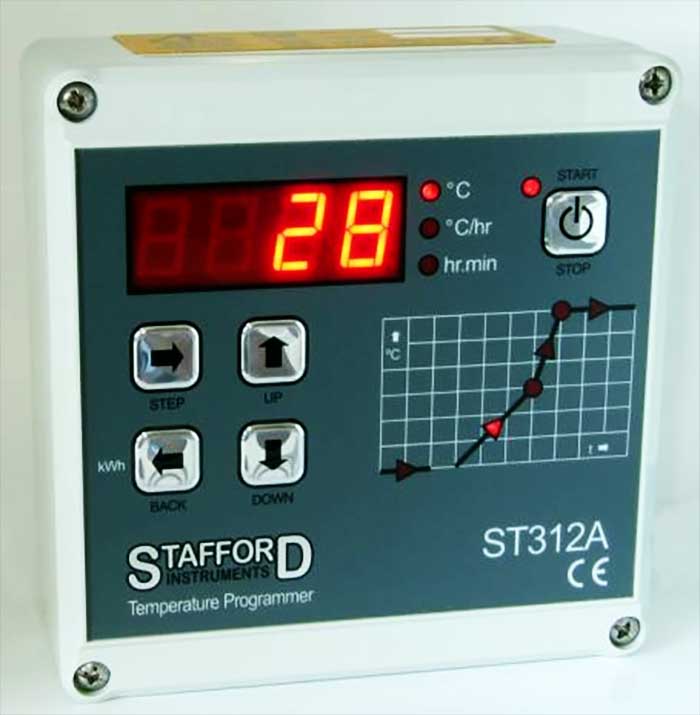
🔥 CONTROLLING THE KILN » HEATING
Critical phases in bisque firing: up to 300°C and between 500°C and 600°C. Solution: The first 300°C as slowly as possible and as a reference never exceed 100°C/hour from the beginning until 600°C.
From 600°C onwards, maximum power in the kiln until the final temperature (depends on the type of firing intended).
In glazing, the concerns of bisque firing do not exist because the pieces have already been fired; however, they will be subjected to chemical transformations again.
In glazing, we can use a much higher ratio (120/180 degrees per hour is acceptable; I do not advise higher) than the 100°C/hour for bisque, depending on the resistance of the material.
In bisque firing, open the chimney up to 500/600° to release gases and vapors. Failure to expel these can cause cracks in the pieces and deteriorates the kiln further.
Greater "load" means more difficulty in reaching the maximum temperature in a low-"power" kiln. The presence of shelves (refractory slabs) greatly contributes to this resistance.
🔥 CONTROLLING THE KILN » COOLING
Let it cool down to room temperature without opening the chimney and door. If we are in a hurry to unload and the pieces are not "fragile" we can: Open the chimney at 400/500 °C; Open the door slightly at 300/400 °C, closing the chimney.
COOLING: do not open chimney and door simultaneously
HEATING: do not open the door when the kiln is on and at high temperatures
NOTE: sometimes pieces crack days after the firing, often due to sudden heating or cooling.
🔥 FINAL SOAK
Inside the kiln, the temperature is not homogeneous. If there are large differences, we need to perform a final soak (obviously only in glazing) to minimize this situation. To overcome this, there are kilns with 2 pyrometric probes…
We have to be careful with the final soak because if the kiln takes a long time to reach the final temperature (low power and/or excessively loaded), a soak of, for example, 30 minutes can be dangerously excessive…